Every network you’ve trained almost certainly leans on the same handful of activation functions — ReLU, GELU, SiLU, tanh. They differ in shape, but they share one quiet assumption: the nonlinearity itself is fixed. You pick one function, wide enough to cover the whole range of inputs a neuron will ever see, bolt it on after every layer, and let gradient descent do the rest with the weights around it. The function itself never adapts.
I’ve been running a long series of experiments that pokes at that assumption directly: what if, instead of every layer reaching for its own fixed function, the entire network shared one single nonlinearity — and that nonlinearity’s own shape were learned, right alongside the weights? Early results say there’s real substance here. But the road to that result has not been a straight line, and that’s most of what makes it worth writing about before the destination is ready to publish.
I’m not naming the mechanism yet. What follows is just the evidence — the promising part and the strange part both.
The promising part
Swap a standard network’s fixed activation for a single shared, adaptive one and train both on the same toy classification problems, same architecture, same optimizer. On the training data itself, the new approach matches or beats the standard network every time — often driving the training loss essentially to zero where the standard network levels off well above it.
The strange part
Then you look at what each model predicts away from the training points — and the two stop looking like variations on the same idea.
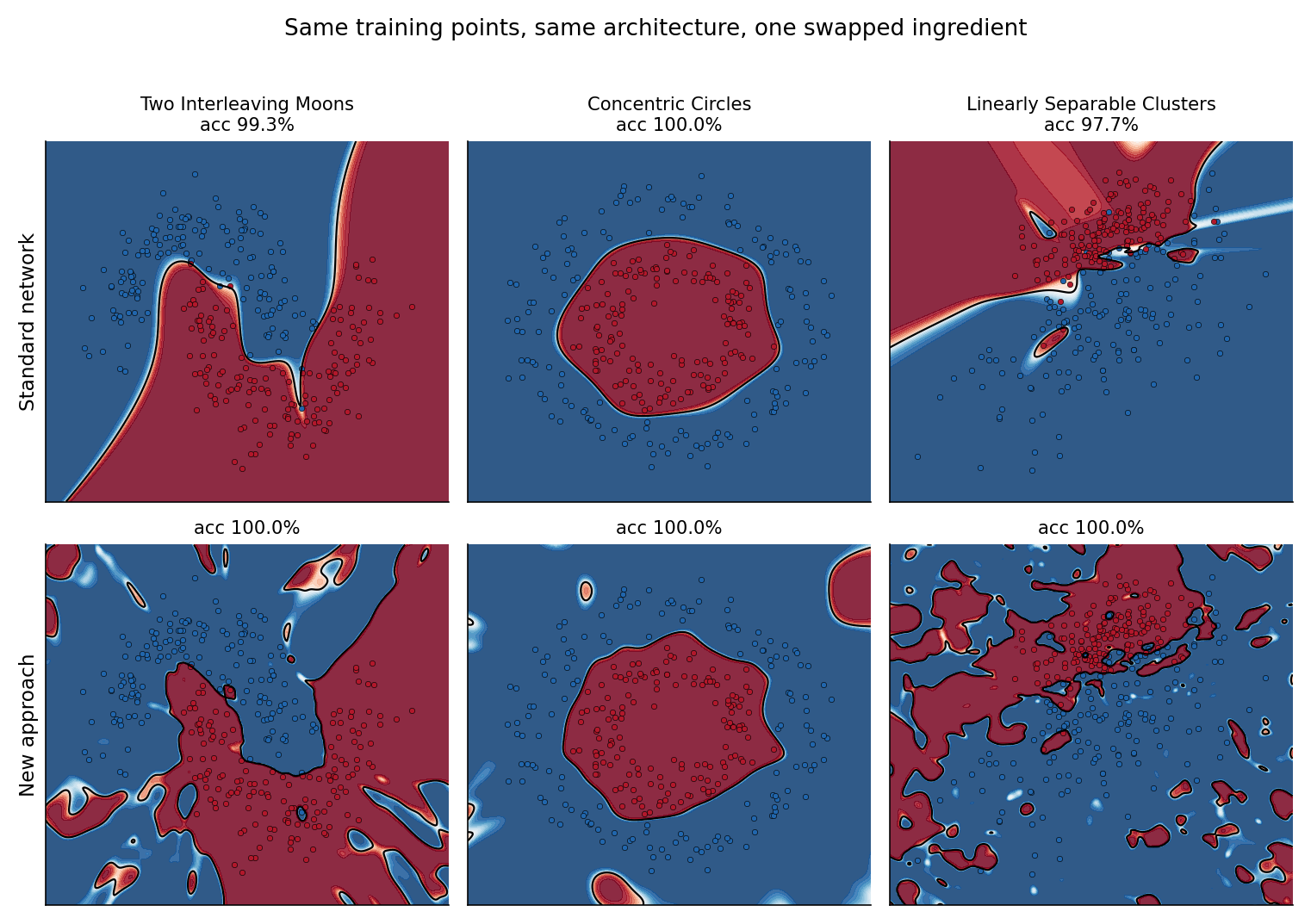
The standard network’s boundary does what you’d hope: a single, smooth dividing line that extrapolates sensibly into empty space. The new approach fits the same points just as well, sometimes better — but tears the rest of the plane into scattered, disconnected islands of high confidence, in places with no training data anywhere nearby. It’s a strange, unforced kind of overfitting: not to noise in the labels, but to something structural in how the new activation behaves once it’s asked to generalize.
That’s the honest state of this thread right now — a real capability with a real, not-yet-fully-tamed side effect. Chasing down why it happens, and which fixes actually address the cause rather than papering over the symptom, has been most of the last few weeks of work.
A genuine surprise, once the side effect is reined in
Not every result from taming that side effect was a wash. At a much smaller network — just 2 units per hidden layer, a fraction of the usual size — one tuned version of the new approach didn’t just match the standard network. It beat it outright, on a dataset the standard network visibly struggled to separate at that size:
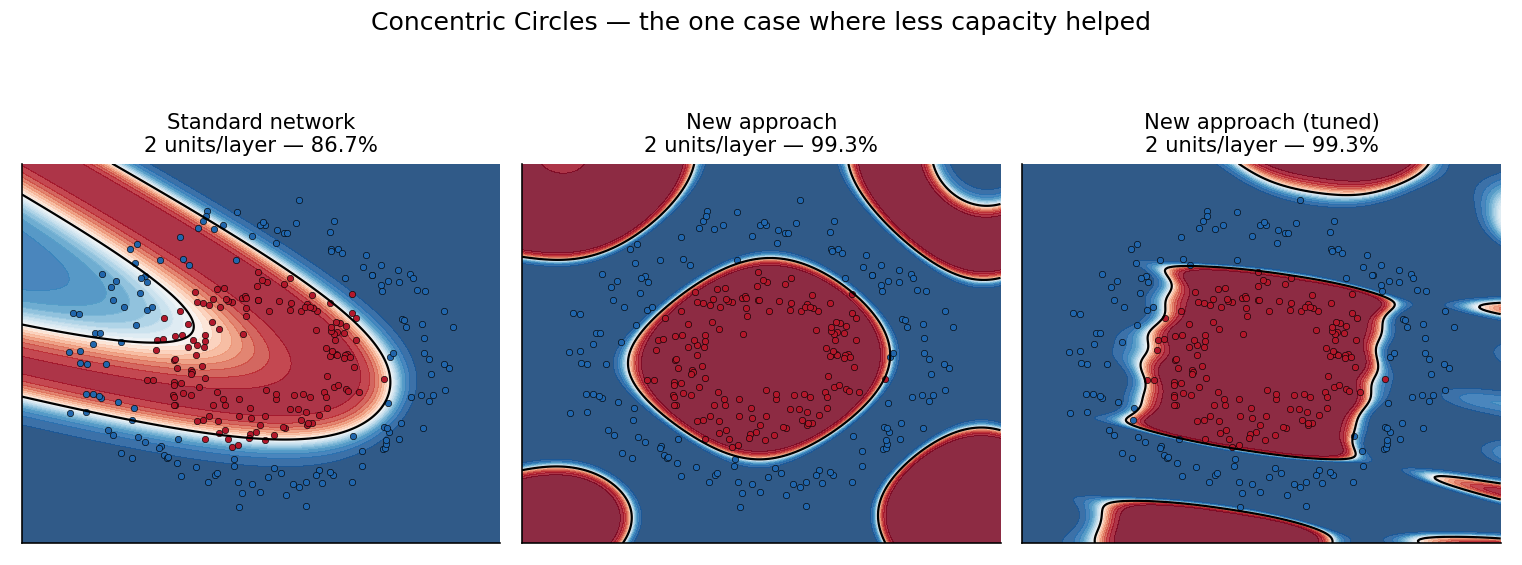
The standard network, squeezed down to two units per layer, can’t quite carve out the enclosed shape this problem needs and settles for a much noisier boundary. The new approach, at the exact same size, gets it clean — with the side effect from the previous section brought under control at the same time. This is the first clear case in this line of work where the new approach isn’t just “as good, differently” — it’s better, in a size regime where the standard function structurally runs out of room.
What actually changed
Here’s the shape of the swap, without the mechanism behind it:
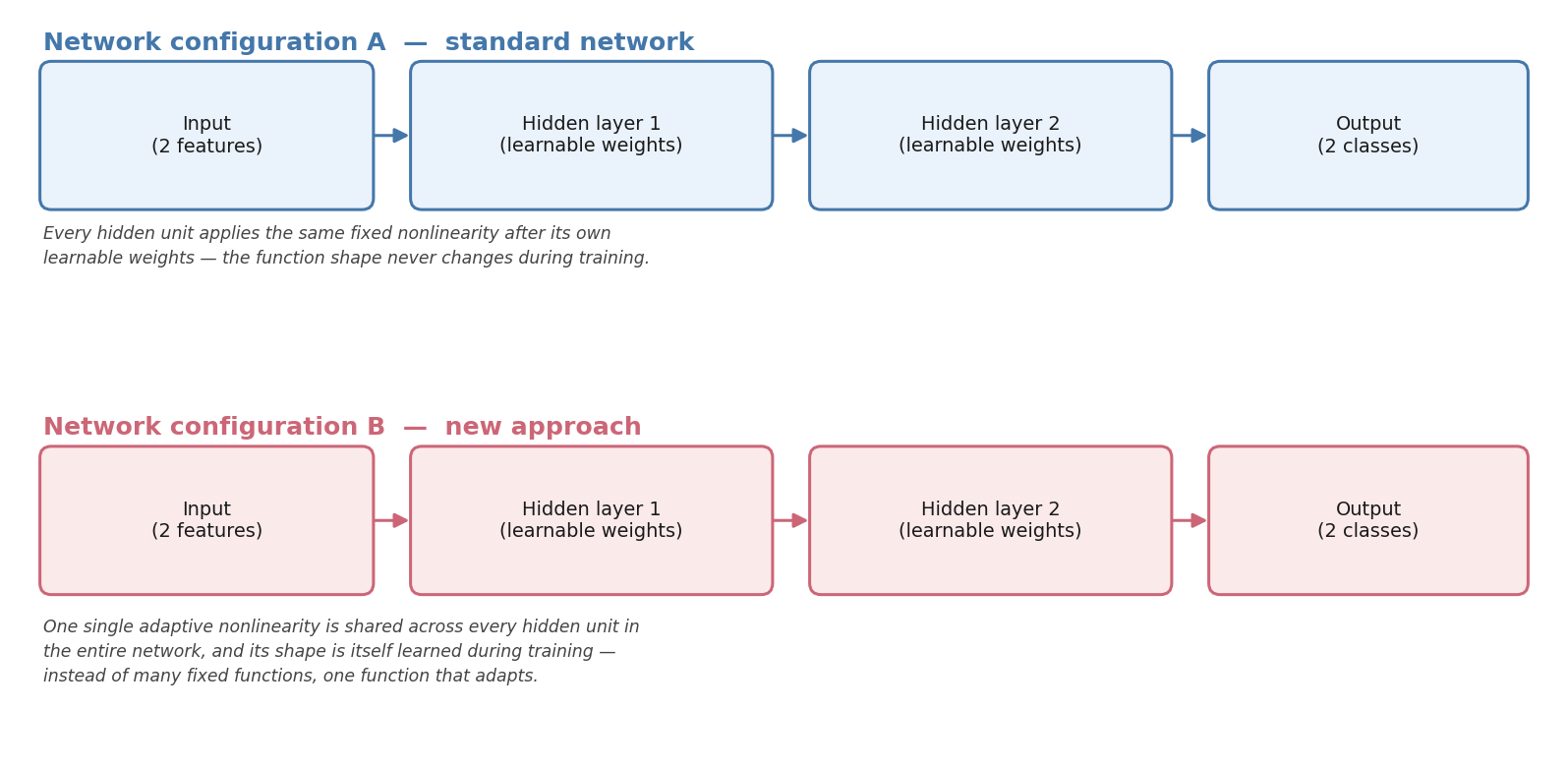
A standard network gives every hidden unit its own copy of one fixed function. This configuration gives the entire network one function instead — and lets that one function’s shape be learned. It’s a genuinely different place to put a network’s flexibility, and both of the results above — the promising fit and the strange fragmentation — trace back to that one change.
I’m keeping the “how” out of this post on purpose. There’s a proper write-up in progress, and it deserves to land in one piece, side effect and fix included, rather than leaking out sideways. But there’s enough here already to say plainly that fixed, wide-range activation functions are leaving something on the table — and that whatever replaces them won’t be simple to get right.
Extensive experimentation is underway. Some surprising results are being cooked.